A Simple Way to Understand Nashville Neighborhoods
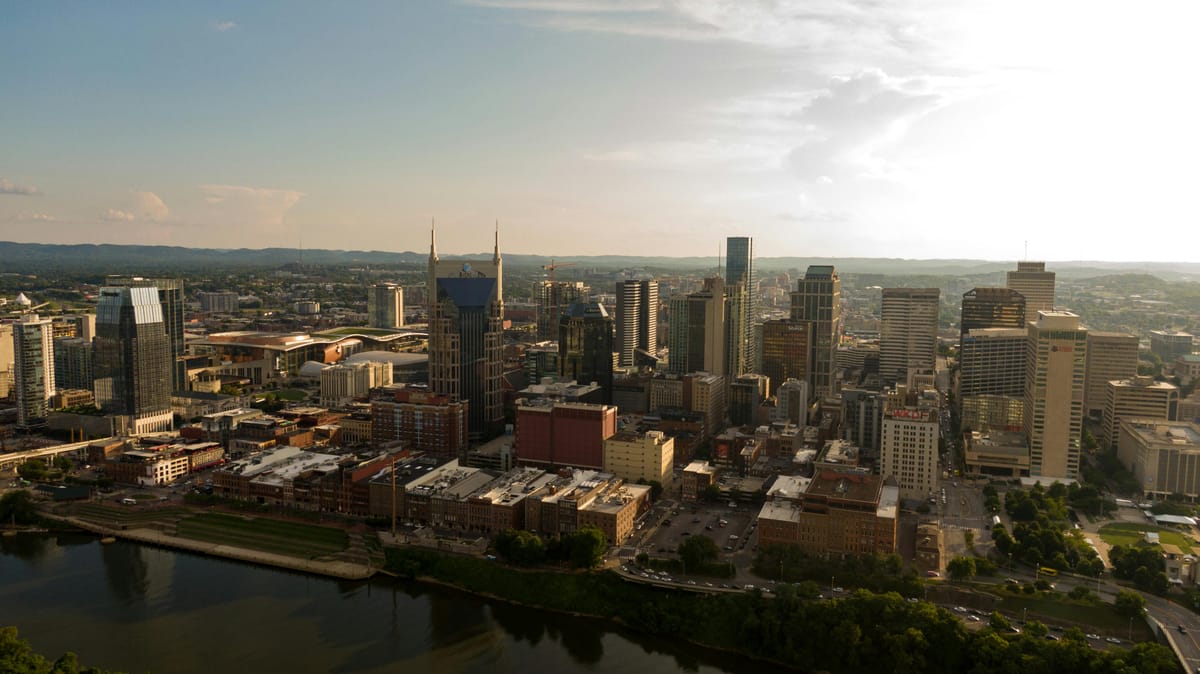
Nashville has around a hundred named neighborhoods, which is why it helps to start with broader areas before narrowing things down.
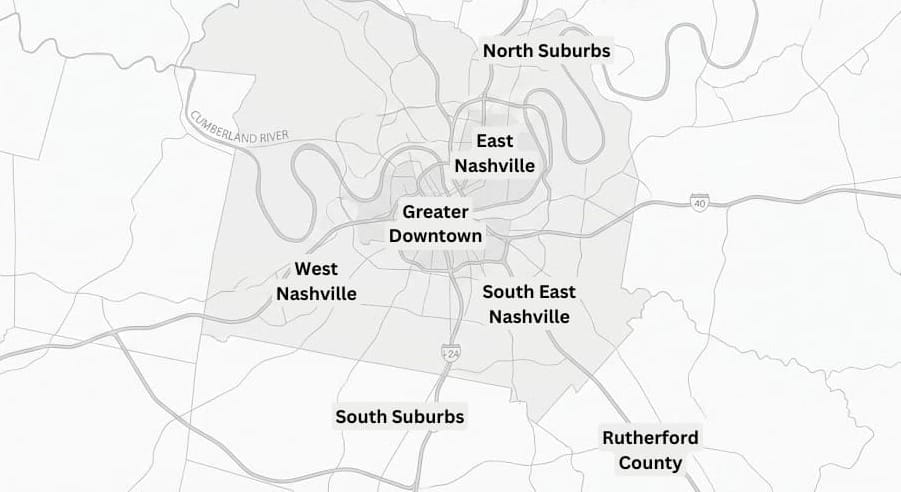
This overview groups neighborhoods by location and proximity to the city, giving you a clearer starting point as you explore your options. While Nashville technically refers to Davidson County, this guide also includes nearby cities and suburbs that are commonly part of the apartment search.
Consider this a legend — a way to orient yourself before diving into individual neighborhoods:
- Greater Downtown
- East Nashville
- West Nashville
- South & Southeast Nashville
- North Suburbs
- South Suburbs
- Rutherford County
Greater Downtown
Central and closest to downtown.
These neighborhoods sit near the heart of the city and are closely connected to downtown and major job centers. While they vary in layout and feel, they’re all considered part of Nashville’s inner core.
- Downtown
- Gulch
- Germantown
- Metrocenter
- North Nashville
- Music Row
- Midtown
- 12 South
- Edgehill
- WeHo (Wedgewood-Houston)
East Nashville
Located east of the river.
These areas share similar geography and commuting patterns, with a more residential layout than the downtown core.
- East Nashville
- Inglewood
- Dickerson Pike
West Nashville
West of downtown, with a mix of residential and newer development.
These neighborhoods offer straightforward access to the city while feeling a bit more spread out.
- The Nations
- Sylvan Park
- West Nashville
- Bellevue
South & Southeast Nashville
Positioned along major highways and near the airport.
These areas are often shaped by their proximity to interstates and travel corridors.
- Berry Hill
- Donelson
- Hermitage
- Antioch
North Suburbs
Heading north, gradually becoming more suburban.
As you move north of the city, neighborhoods tend to open up while remaining connected to Nashville.
- Madison
- Hendersonville
- Gallatin
South Suburbs
Established communities south of the city.
These areas are widely recognized and commonly referenced by name.
- Brentwood
- Franklin
- Spring Hill
Rutherford County
Farther southeast of the city.
These areas sit outside Davidson County and are often considered together due to location.
- Smyrna
- Murfreesboro
A Closer Look at Greater Downtown
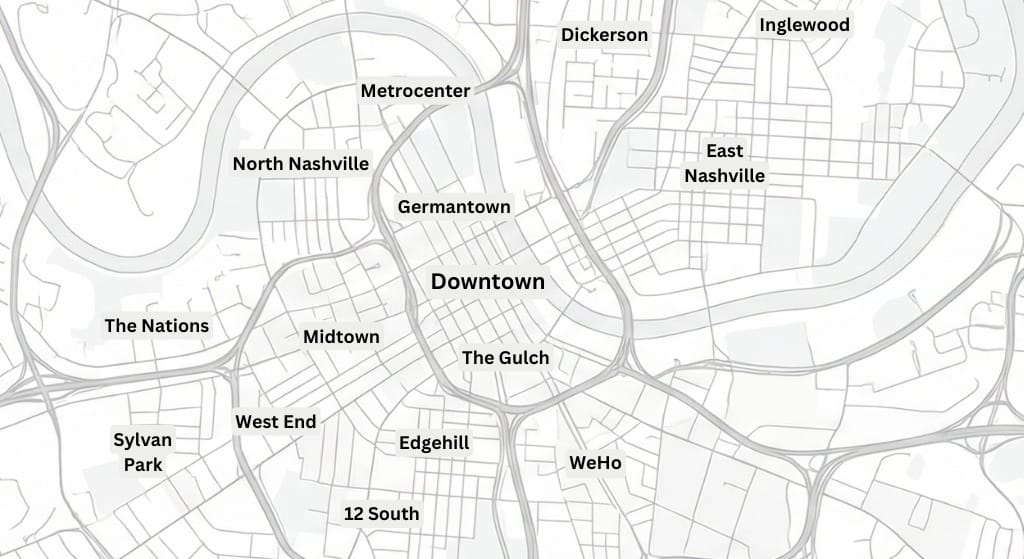
Greater Downtown includes the neighborhoods closest to downtown. While they’re all centrally located, they don’t feel the same day to day. Small shifts in location can affect things like traffic, building style, and how busy an area feels.
Here’s a straightforward breakdown of the core neighborhoods, ordered roughly by location.
Downtown
The center of the city.
Downtown is Nashville’s commercial and activity core. Apartments are primarily high-rise, and there is tends to be constant movement and energy from morning through late night.
The Gulch
Just southwest of downtown, with a dense, modern layout.
The Gulch is a compact, walkable destination with a dense mix of apartment buildings and mixed-use spaces that feel like a modern extension of downtown.
Germantown
Just north of downtown, with a defined neighborhood feel.
Germantown blends historic structures with newer apartment buildings, offering a more block-by-block feel and less uniform density than downtown or the Gulch.
Metrocenter
North of downtown, more spread out.
Metrocenter offers easy access to major roads, and its riverfront greenway adds a welcome sense of open space. It’s not as walkable as the denser downtown areas, but it has advantages of its own.
North Nashville
Northwest of downtown, mostly residential.
North Nashville spans several neighborhoods with varying densities, from long-established residential areas to pockets of newer development.
Music Row
Between downtown and Midtown.
Music Row is centrally located and offers quick access to multiple parts of the city. Apartments here benefit from short travel times in several directions.
Midtown
Dense, central, and well connected.
Midtown is one of the most centrally located residential areas in Nashville. It’s close to major corridors, universities, and hospitals, and tends to stay active throughout the day.
12 South
South of downtown, with a village-style commercial core.
12 South is known for its walkable retail strip, low-rise apartment buildings, and nearby residential streets. It feels polished and approachable, with easy access to Midtown and downtown while maintaining a distinctly neighborhood feel.
Edgehill
Just south of downtown, bordering Midtown and Music Row.
Edgehill sits closer to the urban core and has a more transitional feel. Its location makes it especially convenient for Midtown, Music Row, and downtown access.
WeHo (Wedgewood-Houston)
South-east of downtown, with a distinct creative presence.
WeHo has an eclectic mix of apartment buildings and creative spaces, with a pace and personality that differs from other downtown neighborhoods.

Ioan Ozarchevici
Leasing & Relocation Consultant, Nashville Apartment Locators
License #369903
If you’re apartment hunting in or around Nashville, I help you narrow options, avoid mistakes, and save time — at no cost.
C: 615.602.3000
O: 615.606.APTS
700 Craighead St., Suite 200
Nashville, TN 37204